
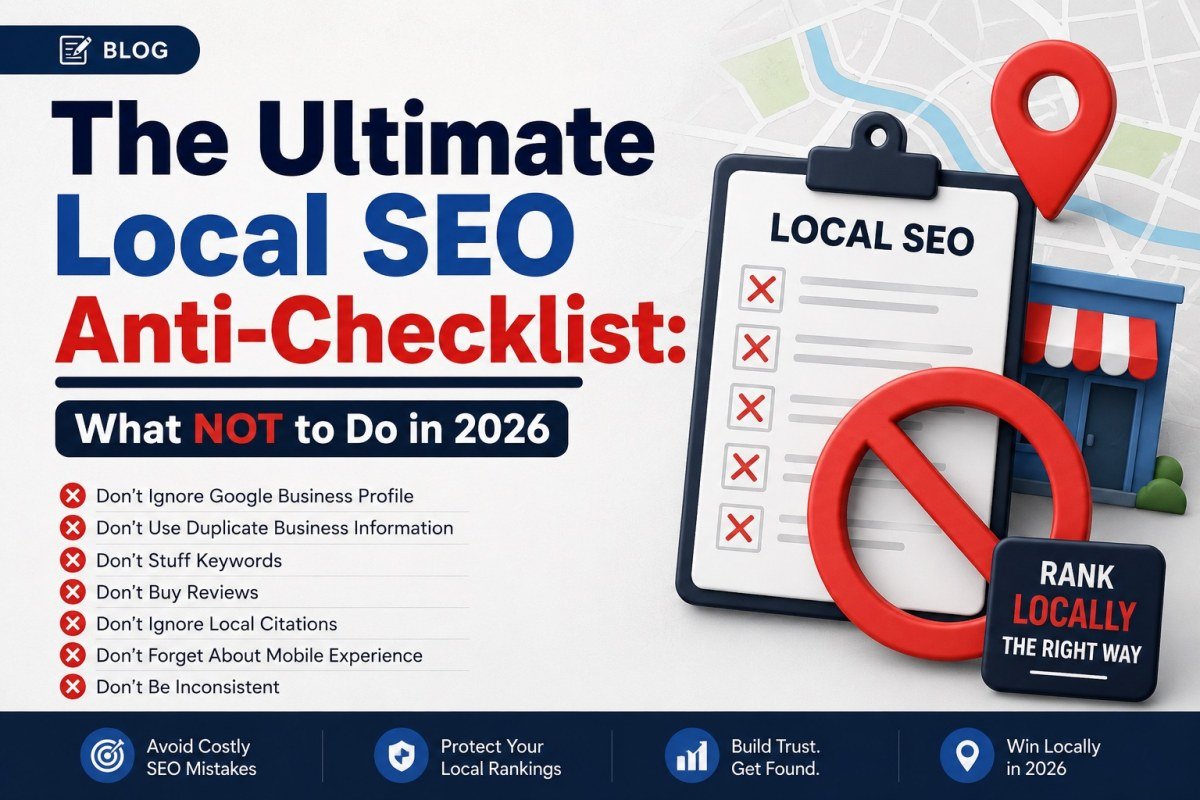
The 2026 local SEO anti-checklist: what not to do with GMB, citations, reviews, mobile, and keywords—and the practices that keep you visible locally.
In 2026, local SEO has transformed dramatically, driven by advancements in technology and consumer behavior. Consumers rely heavily on their mobile devices for local searches. This means businesses must prioritize their online presence to remain visible. The competition is fierce. Companies are racing to optimize their local SEO strategies to attract nearby customers.
Voice search is becoming increasingly popular, adding another layer of complexity to local SEO. Users often ask questions rather than type keywords. Therefore, businesses must adapt their content strategies. Focused, conversational phrases take precedence over traditional keyword usage.
Moreover, the importance of local citations has notably increased. Accurate, consistent business information across online platforms boosts credibility. Google rewards businesses that provide trustworthy data to users. It enhances visibility in local search results.
In this landscape, varying search algorithms play a crucial role. Businesses must stay updated with the latest changes. Being proactive in adapting strategies is essential for success in local search marketing. This ensures firms not only remain relevant but also outperform competitors.
Investing in advanced local SEO tools becomes critical. These tools aid in auditing performance, managing listings, and monitoring reviews, providing insights necessary for staying ahead in the local SEO game. Smart approaches to local SEO are vital for businesses in 2026.
Common Local SEO Mistakes
Many businesses fall victim to common local SEO mistakes that hinder their visibility. A prevalent error is overlooking mobile optimization. Given the rise of mobile search, failing to provide a mobile-friendly experience can drive potential customers away.
Another mistake involves neglecting website loading speed. A slow-loading site can frustrate users, leading them to abandon their search. Google also considers page speed as a ranking factor, making expedience crucial for local SEO success. Ensuring a fast and smooth browsing experience is a must.
Businesses often underestimate the importance of local backlinks. Building relationships with local entities can significantly enhance search rankings. Ignoring local partnerships can lead to missed opportunities in customer outreach.
Failing to keep business listings consistent is another common downfall. Inaccurate information across platforms confuses potential customers and negatively impacts search rankings. Regular audits of business listings can help maintain accuracy.
Additionally, many overlook the power of reviews. Customer feedback can impact a business's reputation and search visibility. Encouraging satisfied customers to leave positive reviews can build trust and attract new clients. It's important to actively manage and respond to reviews as part of your local SEO strategy.
Neglecting Google Business Profile Optimization
One of the most critical mistakes in local SEO is neglecting Google Business Profile optimization. Your Google Business Profile is often the first point of contact for potential customers. An incomplete or unoptimized profile can lead to missed opportunities.
Many businesses fail to claim their Google Business Profile. A claimed profile allows you to control how your business appears in local searches. It's essential to verify and optimize this listing to enhance visibility.
Inadequate information can deter customers. Ensure your business hours, contact numbers, and website link are accurate. Incorporate relevant categories to improve search queries. The right categories not only help customers find you but also increase your chances of appearing in local search results.
Another common oversight is not utilizing images. Businesses that showcase high-quality images significantly enhance their appeal. Attractive visuals create a positive first impression and encourage interaction. Regularly update your images to reflect your brand accurately.
Additionally, ignoring the Questions and Answers section can be detrimental. Engage with potential customers by answering frequently asked questions. This demonstrates authority and improves customer trust, assisting further in local SEO efforts.
Ignoring Local Citations and NAP Consistency
Local citations are mentions of your business name, address, and phone number (NAP) across various online directories and platforms. Ignoring local citations can lead to confusion among search engines and potential customers. When your NAP is inconsistent, it hampers your local search performance. Search engines rely on NAP consistency to validate the legitimacy of your business. Inconsistent citations can hurt your ranking in local search results.
Ensure your NAP information is uniform across all platforms. This includes social media profiles, Google My Business, and local business directories. When discrepancies occur, search engines struggle to determine which information is accurate. This inconsistency can result in lower visibility for your business.
Furthermore, neglecting local citations can lead to missed opportunities for customer engagement. Local listings are often among the first points of contact between potential customers and your business. If that information is inaccurate, businesses can easily lose customers to competitors. Therefore, maintaining accurate and consistent NAP information is vital for strengthening your local SEO strategy and enhancing overall visibility.
Overlooking Customer Reviews and Reputation Management
Your online reputation significantly influences potential customers' decisions. Overlooking customer reviews can damage your credibility and positioning in local search results. Search engines consider customer reviews as a ranking factor. A business with a higher volume of positive reviews will naturally rank better than a competitor with few or negative reviews.
Actively managing your review profile not only improves your local SEO but also fosters customer trust. Engaging with your customers through timely responses, both to positive and negative reviews, shows that you value their opinions. Ignoring negative feedback can spiral into poor customer satisfaction, affecting your brand image.
Encourage satisfied customers to leave positive reviews to enhance your online presence. Doing so will boost your legitimacy and create a positive feedback loop, attracting more customers. Establishing a solid reputation management strategy is essential in today's digital landscape. Invest time in monitoring, responding, and nurturing customer relationships to improve your overall local SEO performance.
Failing to Optimize for Mobile Search
With increasing mobile device usage, optimizing for mobile search has become crucial for local SEO success. Failing to cater to mobile users can severely limit your online visibility. Mobile devices account for a significant portion of local searches. If your website isn't mobile-friendly, potential customers might bounce away in frustration.
Responsive web design is essential for providing a seamless user experience across all devices. Ensure your website loads quickly and displays correctly on smartphones and tablets. Google prioritizes mobile-optimized websites in search results, reinforcing the need for effective mobile strategies. Ignoring this aspect can lead to lost website traffic and revenue.
Incorporate local keywords in your content, focusing on phrases your audience uses when searching locally via mobile. Implementing features like click-to-call buttons can enhance user engagement by making it easier for customers to reach you directly. Mobile optimization isn't merely an option; it's a necessity in today's competitive market. Prioritize your mobile strategy to attract and retain local customers effectively.
Disregarding Localized Content Creation
Many businesses overlook the importance of localized content creation in their local SEO strategy. They mistakenly believe that generic content will suffice in attracting local customers. However, this is a significant mistake. Local audiences look for specific, relevant information that speaks directly to their needs and experiences.
Localized content includes details such as local landmarks, community events, or regional terminology. By incorporating these elements, businesses can make their content more relatable and engaging for the local audience. Blogs that discuss local happenings or guides tailored to specific neighborhoods can significantly enhance user engagement.
Additionally, search engines favor localized content. Websites that exhibit relevance to a specific area often rank higher in local search results. This results in increased visibility and ultimately drives more foot traffic and online conversions.
Neglecting localized content creation leads to a one-size-fits-all approach that fails to capture the essence of local search intent. Investing time and effort into creating tailored content can yield substantial benefits. In a competitive landscape, localized content can differentiate your business from others, making it imperative for any successful local SEO strategy.
Using Vague Keywords Without Local Intent
Another common error is the use of vague keywords devoid of local intent. Businesses often focus on general terms rather than incorporating localized search phrases that connect them to their community. For instance, a restaurant shouldn't just target "pizza" but "best pizza in [City Name]." This specificity helps search engines understand both the relevance and location of the business.
Keywords create the foundation for your local SEO strategy. Keywords that lack local intent can dilute your online visibility. They attract broad audiences that may not convert, as they are likely searching from distant locations. On the contrary, local keywords target users actively seeking services or products in their area, increasing the chances of attracting qualified leads.
Moreover, local intent keywords improve your chances of appearing in local search features like the Google Local Pack. When users search for "plumber near me," search engines prioritize businesses optimizing for local queries over generic phrases. Therefore, thorough keyword research should emphasize optimizing for local intent, focusing on geographic relevance whenever possible.
Without targeting local intent keywords, businesses risk losing the valuable opportunity to connect with potential customers right in their neighborhood. Crafting a solid keyword strategy is vital for success in today's local search environment.
Skipping Technical SEO Considerations
In the quest for ranking higher in local search results, many businesses ignore essential technical SEO considerations. Just as content is crucial, so too is ensuring the technical elements of a website function seamlessly. Neglecting this aspect can create barriers to search engines crawling and indexing your site, ultimately impacting your visibility.
Technical SEO includes optimizing your site's speed, mobile responsiveness, and secure protocols like HTTPS. A slow-loading website can frustrate users, resulting in high bounce rates. On the other hand, a mobile-friendly site ensures accessibility for users searching on their phones, which make up a significant portion of local searches.
Additionally, structured data markup plays a vital role in local SEO. By enhancing the way search engines interpret your content, structured data helps present better information in local searches. Without this markup, your business may miss out on appearing in rich snippets or local packs.
Skipping technical SEO can diminish all your efforts related to content creation and keyword optimization. Therefore, a holistic approach that includes sound technical foundations is essential. By doing this, you create an efficient and user-friendly website, paving the way for higher rankings and enhanced visibility in local search.
Not Tracking Local SEO Performance
One of the gravest mistakes businesses can make is neglecting to track local SEO performance. Without measurement, you have no way of knowing what works and what doesn't. Ignoring data can lead to ineffective strategies that waste time and budget. It's vital to use tools that can offer detailed insights into your local search rankings.
Metrics such as local visibility, organic traffic growth, and keyword rankings are critical. Regular audits will help identify areas for improvement. Are you ranking for the right local keywords? How are customers finding you? Tracking performance answers these questions.
Failing to assess your local SEO can also allow competitors to gain an advantage. They might adapt their strategies while you remain oblivious to shifts in the market. Utilize platforms like Local SEO Tool, which provides analytics and reporting features. These tools can elevate your strategy, making it data-driven rather than guesswork. Consistent tracking not only sharpens your strategy but also aids in better investment decisions for future campaigns.
Underestimating the Power of Social Signals
Social signals play a crucial role in local SEO, and underestimating their impact is a common pitfall. Search engines increasingly use social engagement to gauge a business's credibility and relevance. Having an active social media presence can enhance your brand's visibility and customer trust.
When users share, like, or comment on your posts, it generates signals that indicate popularity and authority. These interactions can amplify your local search ranking. It's not just about followers; engagement matters even more. Businesses need to actively participate in social conversations and respond to customer inquiries.
Neglecting social media can leave you out of vital customer interactions. Plus, ignoring this platform may limit your ability to connect with your audience. Consider integrating social media campaigns into your local SEO strategy. Share local content, promotions, and customer testimonials. This approach not only boosts engagement but also drives traffic to your website, enhancing your overall local SEO performance.
Avoiding Paid Advertising and Local Promotions
A common mistake businesses make is avoiding paid advertising and local promotions altogether. While organic methods are essential, paid strategies can accelerate visibility. PPC, social media ads, and local promotions can place your business in front of your target audience when they need your services the most.
Local promotions can draw immediate attention and encourage foot traffic. For instance, utilizing Google Ads with localized keywords connects you with customers actively searching for your offerings. This targeted approach is invaluable, particularly in competitive markets, where organic results may take time to improve.
Additionally, seasonal promotions and local events can be quite fruitful. These strategies not only boost awareness but also enhance customer loyalty. Partnering with local businesses for joint promotions can expand your reach and tap into established customer bases. In an era where consumers appreciate targeted marketing, ignoring paid advertising is a lost opportunity for growth. Investing in these techniques ensures your business continues to attract local customers effectively.
Conclusion: Best Practices for Successful Local SEO in 2026
To succeed in local SEO in 2026, businesses must focus on delivering high-quality content that addresses the needs of their local audience. This means understanding local trends, culture, and preferences. Crafting content that resonates with your community will not only enhance engagement but also improve your ranking in local search results.
Additionally, a mobile-first approach is crucial. More users are searching for local businesses via their smartphones. Ensure your website is mobile-optimized with fast loading times and a user-friendly interface. Local searchers often look for immediate solutions. By providing an excellent mobile experience, you can capture this audience effectively.
Furthermore, leveraging local business listings is essential. Ensure your information is consistent across platforms such as Google My Business, Yelp, and social media. Accurate listings boost credibility and visibility in searches. Don't overlook the importance of customer reviews. Actively encourage satisfied clients to leave positive feedback. Responding to reviews shows potential customers that you value their opinions.
Lastly, utilize advanced local SEO tools like those offered by Local SEO Tool. These tools can help you track performance, analyze competitors, and optimize your strategies effectively. Embrace the potential of AI technology to stay ahead and refine your approach consistently.