
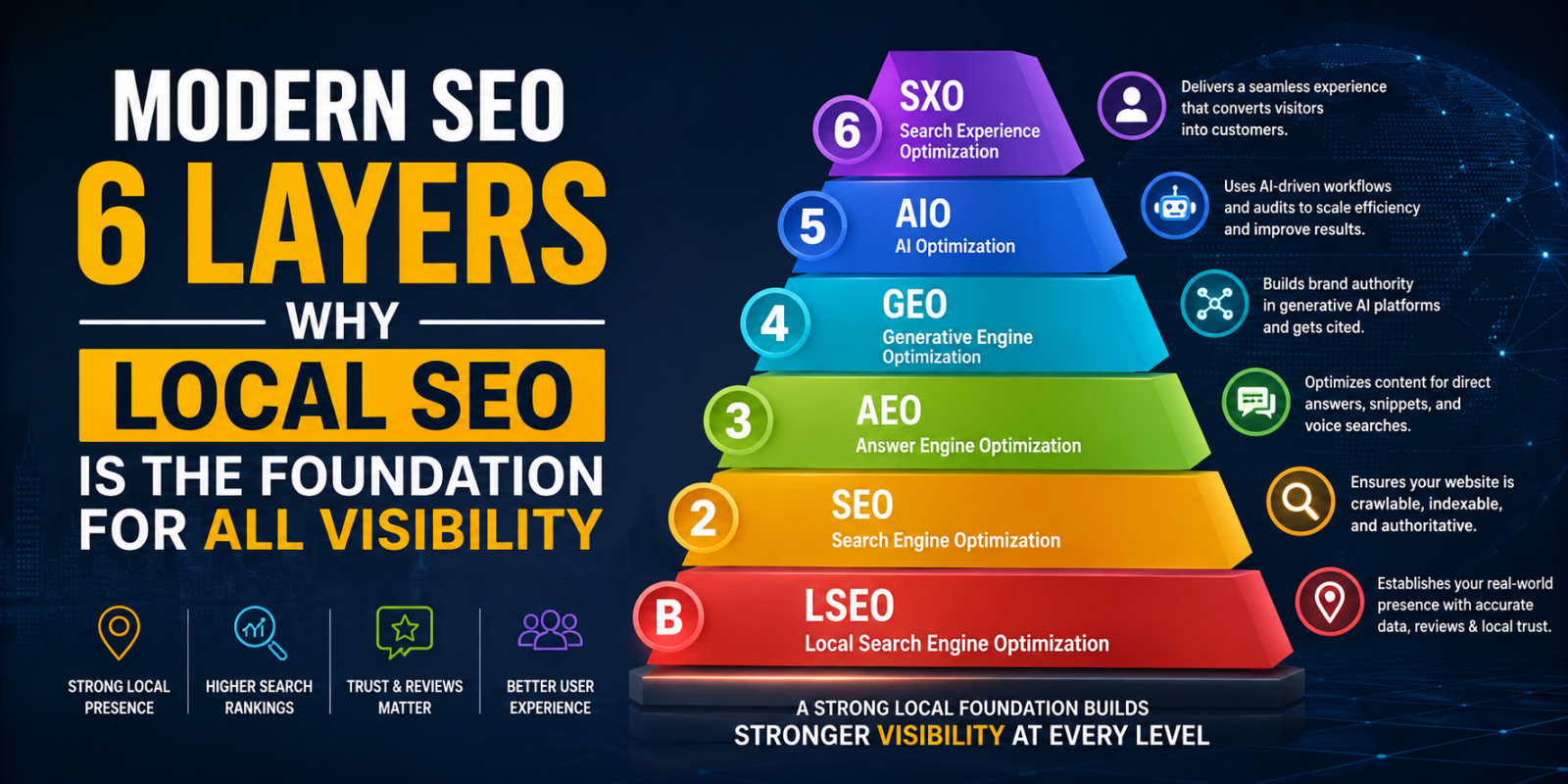
Search optimization has changed far beyond the traditional approach of targeting keywords, publishing content, and earning backlinks. Today, a business can be discovered through Google Search, Maps, featured answers, voice assistants, AI-generated recommendations, review platforms, and other digital experiences.
This means modern SEO should not be viewed as a single activity.
It is better understood as a connected system made up of several optimization layers. Each layer addresses a different stage of the search journey, from establishing a business's local identity to helping users find information, interact with a brand, and ultimately become customers.
One of the most important layers for location-based businesses is Local Search Engine Optimization (LSEO).
Local SEO helps establish the real-world identity of a business through information such as its location, services, contact details, categories, reviews, and online references. Once these foundational signals are organized properly, other search strategies can work more effectively around them.
This creates a practical six-layer model:
LSEO → SEO → AEO → GEO → AIO → SXO
Let's examine how these layers work and why the foundation matters.
The 6-Layer Modern Search Framework
Modern search optimization can be divided into six interconnected areas.
The layers are not completely independent.
A business can work on all six simultaneously, but the quality of its foundational information can influence how effectively the upper layers perform.
Layer 1: LSEO - Local Search Engine Optimization
Local SEO is concerned with connecting a business to a specific geographic market.
For example, a customer searching for:
- Physiotherapist in Vastrapur
- Pest control company in Ahmedabad
- Restaurant near BKC
- AC repair service near me
- Real estate company in Ahmedabad
is expressing a location-related need.
Local SEO helps search systems understand which businesses are relevant to those searches.
Important local optimization elements include:
- Google Business Profile
- Business categories
- Name, address and phone information
- Local citations
- Customer reviews
- Location pages
- Service-area information
- Local content
- Business photos
- Consistent contact information
The objective is not simply to place a business name on as many websites as possible.
The real objective is to create a clear, accurate and trustworthy digital representation of the business.
Layer 2: SEO - Search Engine Optimization
Traditional SEO focuses primarily on making a website accessible, understandable, useful, and authoritative.
This includes areas such as:
- Technical SEO
- Website architecture
- Crawlability
- Indexing
- Keyword research
- Search intent
- On-page optimization
- Internal linking
- Content development
- Backlink acquisition
- Mobile usability
- Website performance
Suppose a local business has a properly optimized Google Business Profile but its website contains broken pages, poor navigation, duplicate content, or indexing problems.
Its local presence alone cannot solve every website-related issue.
This is why LSEO and traditional SEO should complement each other.
LSEO establishes the local business context, while SEO strengthens the website that represents the business online.
Layer 3: AEO - Answer Engine Optimization
Searchers increasingly use questions instead of short keyword phrases.
For example:
What should I check before choosing a physiotherapist?
How often should commercial AC filters be replaced?
What are the benefits of PUF panels?
Which pest control treatment is suitable for termites?
This type of search behavior makes direct, well-structured answers increasingly important.
AEO focuses on organizing information so that search systems can identify useful answers quickly.
AEO strategies may include:
- FAQ sections
- Question-based headings
- Short answer paragraphs
- Structured content
- Schema markup
- Step-by-step explanations
- Definitions
- Comparison sections
- Clear search-intent targeting
The goal is not to force a webpage into a featured snippet.
Instead, the objective is to make the information clear enough for search systems and users to understand efficiently.
Layer 4: GEO - Generative Engine Optimization
The growth of generative AI has created another search environment.
People can now ask AI systems to:
- Recommend businesses
- Compare products
- Explain services
- Find local providers
- Summarize information
- Research companies
- Identify suitable solutions
This has created interest in Generative Engine Optimization, commonly abbreviated as GEO.
GEO focuses on improving how clearly a brand or business is represented across information sources that may influence generative search experiences.
Important considerations can include:
- Brand consistency
- Entity information
- Authoritative content
- Relevant third-party mentions
- Business references
- Structured information
- Topical expertise
- Supporting online sources
However, GEO should not be treated as a magic technique that guarantees an AI recommendation.
Generative systems use different sources and processes, and their outputs can change.
A more practical goal is to make the business accurately represented, clearly identifiable, and supported by trustworthy information across the web.
Layer 5: AIO - AI Optimization
AIO can be understood as the use of artificial intelligence to improve the optimization process itself.
This is different from simply writing articles with AI.
AI can assist SEO professionals with activities such as:
- Website auditing
- Competitor research
- Semantic analysis
- Content gap identification
- Keyword clustering
- Local listing analysis
- Data organization
- Reporting
- Search trend analysis
- Workflow automation
For agencies and businesses managing multiple websites or locations, AI-assisted workflows can reduce repetitive manual work.
For example, an SEO team could use automation to identify inconsistent business information across multiple listings and then manually review the findings before making corrections.
The important principle is:
AI should improve the process, not replace strategic judgment.
Layer 6: SXO - Search Experience Optimization
Ranking is not the final destination.
A business may receive impressions, clicks, calls, or visitors, but the real business objective is usually conversion.
This is where Search Experience Optimization becomes important.
SXO combines search visibility with the experience users receive after discovering the business.
Important areas include:
- Search intent
- Page relevance
- Website navigation
- Mobile experience
- Page speed
- Core Web Vitals
- Calls to action
- Contact accessibility
- Trust signals
- Conversion-focused page design
- Content readability
Imagine someone searches for:
"dentist near me."
They discover a dental clinic through search and visit the website.
If the website takes too long to load, hides the phone number, provides no appointment option, or sends the visitor to an irrelevant page, the original search visibility may not produce a business result.
Therefore:
Visibility attracts the user. Experience influences what happens next.
Why Local SEO Forms an Important Foundation
Local SEO deserves special attention because it deals with information that connects a digital profile to a real-world business.
Search engines need to understand basic information about a company.
For example:
What is the business called?
Where does it operate?
What services does it provide?
Which category does it belong to?
How can customers contact it?
What do customers say about their experiences?
Local SEO helps organize many of these signals.
This makes it particularly important for businesses with physical locations or defined service areas.
1. Local Signals Help Clarify Business Identity
Search engines may encounter information about the same company in many places.
For example:
- Company website
- Google Business Profile
- Business directories
- Social profiles
- Review platforms
- Industry websites
- Local publications
If these sources consistently describe the same organization, it becomes easier to understand that the references relate to one business entity.
This is one reason accurate business information matters.
A business should avoid unnecessary differences in its core details across important platforms.
2. NAP Information Provides Basic Business Context
NAP means:
Name, Address and Phone Number.
These details are among the most basic pieces of local business information.
For example, if a company changes its address but old directories continue displaying the previous location, customers can receive conflicting information.
Maintaining accurate information across important platforms helps reduce confusion.
However, modern local SEO should not be reduced to citation quantity.
A hundred low-quality listings are not automatically better than a smaller collection of accurate, relevant business references.
Quality and consistency should come before volume.
3. Google Business Profile Is a Major Local Search Asset
For eligible businesses, Google Business Profile provides a direct way to present important information to customers within Google's ecosystem.
A profile may communicate:
- Business name
- Category
- Address
- Service area
- Hours
- Website
- Phone number
- Photos
- Reviews
- Services
- Products
- Updates
This information can influence how users perceive a business before visiting its website.
For local businesses, maintaining the profile should therefore be considered part of ongoing digital marketing rather than a one-time setup task.
4. Reviews Add Customer Experience Signals
Reviews have an obvious role in consumer decision-making.
If two businesses offer similar services, customers may examine ratings and reviews before choosing between them.
Reviews can also describe specific experiences.
For example, customers might naturally mention:
- "quick AC repair"
- "helpful physiotherapist"
- "termite treatment"
- "industrial insulation"
- "same-day service"
- "professional installation"
These descriptions can provide useful context about how customers perceive the business.
However, businesses should seek real customer feedback rather than attempting to manipulate reviews.
Authentic experiences are more valuable for long-term reputation.
5. Local Searches Often Reflect Immediate Needs
Location-based queries frequently have strong commercial intent.
Compare:
"What is physiotherapy?"
with:
"physiotherapist near me."
The first query is primarily informational.
The second could indicate that the person is actively looking for a provider.
The same pattern appears across many industries:
- "car repair near me"
- "restaurant near me"
- "pest control Ahmedabad"
- "dentist near Vastrapur"
- "AC service near me"
- "real estate builders Ahmedabad"
For businesses serving local customers, appearing at the right moment can generate valuable actions such as:
- Calls
- Website visits
- Directions
- Enquiries
- Bookings
- Quote requests
- Store visits
This makes local SEO closely connected with revenue generation.
6. Local SEO and Website SEO Strengthen Each Other
A local profile and a website should not tell two different stories.
Suppose a company provides commercial pest control in Ahmedabad.
Its local profile identifies the business as a pest control provider in the region.
Its website can reinforce that relevance through useful pages covering:
- Commercial pest control
- Residential pest control
- Termite treatment
- Pest prevention
- Service areas
- FAQs
- Contact information
When the information is accurate and consistent, users receive a clearer picture of the business.
This creates a stronger overall digital presence.
How the Six Layers Connect
The six-layer model works best when each stage supports the next.
LSEO Builds the Local Context
Local SEO answers:
Who is this business and where does it operate?
It establishes the basic local context.
↓
SEO Strengthens the Website
Traditional SEO answers:
Can search engines discover, understand and evaluate this website?
↓
AEO Organizes Answers
AEO asks:
Can important information be presented clearly enough to answer user questions?
↓
GEO Expands Generative Visibility
GEO focuses on:
Can the brand be clearly understood and represented in generative search environments?
↓
AIO Improves the Process
AIO asks:
How can technology make research, analysis, monitoring and optimization more efficient?
↓
SXO Completes the Journey
SXO focuses on:
What happens after someone discovers the business?
This creates a connected pathway:
Local Identity → Website Visibility → Answers → Generative Discovery → AI-Assisted Optimization → User Experience
Why Businesses Should Not Jump Straight to AI Search
AI search is attracting enormous attention, but businesses should not ignore their fundamental digital presence.
Consider a company that wants to appear in AI-generated recommendations.
If its:
- Business name is inconsistent
- Location information is outdated
- Website is poorly structured
- Services are unclear
- Reviews are limited
- Local profile is incomplete
- Contact information conflicts across platforms
then simply creating GEO-focused content will not solve the underlying problems.
The first step should be establishing a reliable digital foundation.
Once the fundamentals are in place, advanced search strategies become more useful.
Modern SEO Is About Connected Signals
Search visibility increasingly depends on multiple signals working together.
A customer might discover a business through Google Maps, read reviews, visit its website, search the company name again, and then contact the business.
Another customer might discover a brand through an AI-generated recommendation and then verify it through Google Search.
A third person might see a local listing, compare competitors, read FAQs, and submit an enquiry.
The journey is no longer necessarily:
Search → Click → Website → Conversion
Instead, it may look like:
Search → Maps → Reviews → Website → Brand Search → Conversion
or:
AI Recommendation → Search → Business Profile → Website → Enquiry
This is why businesses need consistency across their digital ecosystem.
A Practical Checklist for the 6-Layer SEO Model
Businesses can evaluate their current strategy using six simple stages.
LSEO
- Is the Google Business Profile accurate?
- Are the business categories relevant?
- Is the location information correct?
- Are important citations consistent?
- Are genuine customer reviews being collected?
- Are local service pages available?
SEO
- Can search engines crawl the website?
- Are important pages indexed?
- Is the site structure logical?
- Is content aligned with search intent?
- Are internal links useful?
- Does the website perform well on mobile devices?
AEO
- Does the website answer common customer questions?
- Are FAQs useful and specific?
- Are important answers easy to locate?
- Is structured data implemented appropriately?
- Does content address informational search intent?
GEO
- Is the brand information consistent?
- Are authoritative sources mentioning the business?
- Is the company clearly represented online?
- Does the website demonstrate topical expertise?
- Are important business facts easy to verify?
AIO
- Are repetitive SEO tasks being automated?
- Is AI being used for research and analysis?
- Are website and listing audits performed regularly?
- Are content gaps being monitored?
- Is performance data being reviewed systematically?
SXO
- Does the page satisfy the visitor's intent?
- Is navigation straightforward?
- Are contact options easy to find?
- Are calls to action clear?
- Is the website mobile-friendly?
- Does the page encourage the desired conversion?
The Correct Order Matters
Businesses often chase the newest SEO trend.
Today that might be generative search.
Tomorrow it could be another form of AI-driven discovery.
But the fundamentals remain important.
A business with inaccurate local information cannot create a strong digital identity simply by publishing more AI-focused content.
Similarly, a website with technical problems will struggle to maximize the value of additional content.
The better approach is to build progressively:
1. Establish the local entity.
2. Strengthen the website.
3. Structure information for direct answers.
4. Improve representation across generative search.
5. Use AI to make optimization more efficient.
6. Improve the experience and conversion journey.
Final Takeaway
Modern SEO is no longer just about ranking a webpage for a keyword.
It is about creating a digital presence that search engines, answer systems, AI platforms, and users can understand consistently.
For local businesses, that process should begin with a strong local foundation.
LSEO establishes the business context.
SEO strengthens the website.
AEO organizes information for questions and answers.
GEO prepares the brand for generative search environments.
AIO improves the research and optimization process.
SXO turns visibility into a better customer experience.
The six layers should therefore be viewed as connected components rather than competing SEO trends.
A business does not need to choose between local SEO and AI optimization.
It needs to build them in the right order.
Build the foundation. Strengthen the structure. Make the information understandable. Expand visibility. Improve the workflow. Then optimize the experience.
That is a more sustainable approach to search visibility in an increasingly AI-driven digital landscape.