
Introduction
Getting a local business to appear when someone searches nearby is not simply a matter of adding a city name to a website.
Local search involves several moving parts. A business needs accurate information across the web, a well-maintained Google Business Profile, relevant local keywords, positive customer reviews, strong location signals, and a way to measure whether those efforts are actually improving visibility.
That is where LocalSEOTool comes into the picture.
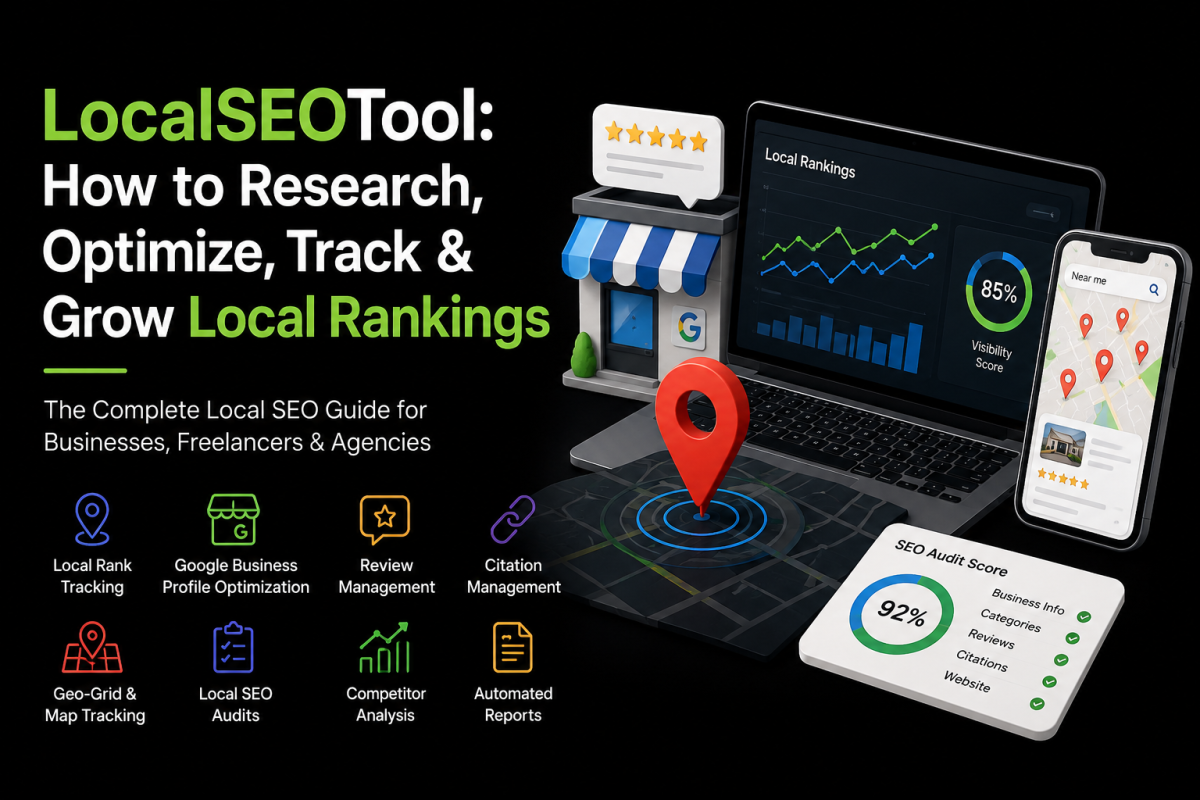
LocalSEOTool is built as an all-in-one platform for managing and improving local search performance. It brings together Google Business Profile management, local rank tracking, geo-grid analysis, citation tracking, review management, SEO audits, automation, and reporting in one place.
Instead of jumping between multiple dashboards to understand what is happening with a local business, marketers can use one workflow to research, optimize, monitor, and report on local SEO performance.
In this guide, we will explore how to use LocalSEOTool as part of a practical local SEO strategy.
What Is LocalSEOTool?
LocalSEOTool is local SEO software designed for businesses, freelancers, agencies, and marketing teams that want to improve their visibility in Google Maps and local search.
The platform combines several common local SEO activities, including:
- Google Business Profile management
- Local keyword research
- Local rank tracking
- Geo-grid and position-map tracking
- Citation monitoring
- Review management
- Google Business Profile audits
- Competitor analysis
- Automated posting
- Local SEO reporting
- GMB mini websites
- SEO workflow automation
The idea is straightforward: instead of treating each local SEO task as a separate project, bring the important parts of the campaign into a connected workflow.
This matters because local SEO is continuous. A profile can be optimized today and still need monitoring next month. Rankings can change by location. Reviews continue to arrive. Competitors update their profiles. Business information can become inconsistent across directories.
A useful local SEO tool therefore needs to help with both optimization and ongoing monitoring.
Why Local SEO Requires More Than Traditional SEO
Traditional SEO often focuses heavily on website rankings.
Local SEO has another layer.
A customer may search for:
“dentist near me”
“best restaurant in Ahmedabad”
“AC repair near me”
“digital marketing agency in Ahmedabad”
The search results may contain websites, advertisements, map results, business profiles, reviews, and other local information.
This means a local business is competing for more than a standard organic position.
A strong local SEO strategy needs to consider:
- Google Business Profile optimization
- Google Maps visibility
- Local keyword relevance
- Website optimization
- Reviews and reputation
- Business citations
- Competitor activity
- Local ranking changes
- Customer actions such as calls and website visits
Managing these signals manually can become difficult, especially when an SEO professional is working with multiple businesses or locations.
That is why a dedicated local SEO platform can make the process more manageable.
How LocalSEOTool Fits Into a Local SEO Strategy
Think of local SEO as a cycle rather than a one-time task:
Research → Audit → Optimize → Publish → Track → Analyze → Improve
LocalSEOTool can support different stages of that cycle.
1. Research
Before changing anything, understand the market.
Research can include:
- Local search terms
- Business categories
- Competitor visibility
- Ranking locations
- Existing citations
- Review patterns
- Google Business Profile information
The goal is not to collect hundreds of keywords just for the sake of having a large spreadsheet.
The goal is to identify searches that represent genuine customer intent.
For example, a local plumbing company might discover that customers search for:
- emergency plumber
- plumber near me
- bathroom plumbing repair
- water pipe repair
- leak detection service
- plumber in [city]
These keywords can then be mapped to appropriate services and locations.
2. Audit the Existing Local Presence
Before building a new strategy, find the weaknesses.
A local SEO audit should look at both the business profile and the wider online presence.
Important areas include:
Google Business Profile
Check:
- Business name
- Primary category
- Secondary categories
- Address
- Phone number
- Website
- Business hours
- Services
- Attributes
- Photos
- Posts
- Reviews
A complete profile gives search engines and customers more useful information about the business.
Citations
Citations are mentions of a business across online directories and platforms.
The important information usually includes the business's:
- Name
- Address
- Phone number
- Website
Inconsistent information can create unnecessary confusion.
A citation tracking workflow can help identify directories that need attention.
Reviews
Reviews are important for reputation and can influence how customers perceive a business.
A local SEO review workflow should monitor:
- New reviews
- Review ratings
- Review volume
- Response activity
- Recurring customer feedback
LocalSEOTool includes a centralized review inbox that allows businesses to view and respond to reviews from a single interface.
3. Optimize Google Business Profile
Google Business Profile is one of the most important assets in a local search campaign.
But optimization does not mean filling every field with keywords.
The profile should accurately describe the real business.
Focus on:
Choose the correct category
The primary category helps communicate what the business actually does.
Choose the category that most closely represents the core service.
Complete business information
Make sure important information is accurate and consistent.
Pay particular attention to:
- Address
- Phone number
- Website
- Opening hours
- Services
Add useful photos
Real business photographs can help customers understand what they can expect.
Depending on the business, useful images may include:
- Storefront
- Interior
- Team
- Products
- Services
- Completed projects
- Work environment
Keep the profile active
Businesses can publish relevant updates and posts rather than leaving the profile untouched for months.
LocalSEOTool includes tools for creating and scheduling posts across Google Business and other supported platforms.
The objective should always be useful communication, not publishing content simply to create activity.
4. Find Local Keyword Opportunities
Keyword research for local SEO is different from simply looking for high-volume terms.
Search intent matters.
Consider the difference between:
“SEO”
and
“SEO agency in Ahmedabad”
The second query communicates location and commercial intent.
Local keyword research should consider:
- Service
- Location
- Search intent
- Customer problem
- Business category
- Geographic area
A useful keyword structure might look like this:
Do not automatically assume that the keyword with the highest search volume is the best keyword.
A lower-volume keyword with strong buying intent can be far more valuable to a local business.
5. Track Local Rankings by Location
One of the biggest challenges in local SEO is that rankings are not always identical everywhere.
A business may appear prominently near its physical location but become less visible several kilometers away.
This is why local rank tracking needs geographic context.
LocalSEOTool provides local keyword tracking with Google Maps data, position-map grids, and competitor listings.
A geo-grid approach can help answer questions such as:
- Where does the business rank strongly?
- Where does visibility decline?
- Which competitors dominate nearby areas?
- Are rankings improving after optimization?
- Which locations need additional attention?
Instead of saying:
“We rank #2.”
An SEO professional can ask a better question:
“Where do we rank #2, and where don't we?”
That distinction can completely change a local SEO strategy.
6. Use Geo-Grid Data to Find Ranking Gaps
A local search grid can turn ranking data into something much easier to understand.
Imagine a business located in the center of a city.
The business might rank:
- Position 2 near the storefront
- Position 4 a few kilometers away
- Position 9 in another neighborhood
- Position 15 on the edge of the target area
That pattern tells you something.
The problem may not be that the business has no local authority. It may have strong visibility close to its location but weaker visibility farther away.
A geo-grid report can help identify those geographic gaps.
From there, an SEO professional can investigate:
- Competitor strength
- Local landing pages
- Citations
- Reviews
- Business categories
- Local backlinks
- On-page relevance
- Service-area targeting
The tool provides the data. The SEO strategy decides what to do with it.
7. Monitor Competitors
Local SEO is competitive.
Your rankings do not exist in isolation.
If a competitor begins collecting more reviews, improving their profile, publishing useful content, or earning local links, their visibility can change.
Competitor analysis should examine:
- Ranking positions
- Google Business Profile strength
- Reviews
- Categories
- Local keywords
- Citations
- Website content
- Local authority
LocalSEOTool includes competitor visibility within its local rank tracking workflow, allowing marketers to compare ranking positions and map visibility.
The objective is not to copy competitors.
Instead, identify what they are doing well and find opportunities they have missed.
8. Manage Local Citations
Citations remain an important part of local business information management.
Imagine a company has:
Business Name: ABC Dental Clinic
Phone: +91 XXX XXX XXXX
Address: Location A
But several directories contain:
ABC Dental
Different phone number
Old address
That inconsistency creates a cleanup task.
A citation management process should include:
- Finding existing listings
- Identifying incorrect information
- Detecting duplicates
- Updating important directories
- Monitoring listing status
LocalSEOTool includes citation directory tracking so businesses and SEO teams can monitor listing information from the platform.
9. Build a Review Management Process
Reviews are not something a business should think about only when its rating falls.
A better approach is to create a repeatable review process.
Step 1: Monitor new reviews
Know when customers leave feedback.
Step 2: Respond consistently
Thank customers who had a positive experience.
For negative feedback, respond professionally and focus on resolving the underlying issue.
Step 3: Look for patterns
Reviews can reveal useful information about:
- Customer service
- Product quality
- Staff behavior
- Waiting time
- Pricing
- Service experience
Step 4: Use feedback operationally
The best review strategy is not only about getting more stars.
It is about learning what customers repeatedly say about the business.
LocalSEOTool provides a centralized review inbox and tools for responding to Google reviews.
10. Automate Repetitive Local SEO Tasks
Local SEO can become repetitive when managing several locations or clients.
For example:
- Checking reviews
- Publishing updates
- Monitoring rankings
- Checking citations
- Creating reports
- Reviewing profile information
Automation can reduce the amount of manual work involved.
LocalSEOTool includes AI-assisted post generation and scheduling for supported business profiles and social platforms.
However, automation should support human judgment.
A useful rule is:
Automate repetition. Keep strategy human.
A scheduled post is easy to create.
Deciding what the business should communicate this month is a strategy decision.
11. Turn Local SEO Data Into Action
Data alone does not improve rankings.
This is where many SEO dashboards fall short.
A report might tell you:
Keyword: emergency plumber
Ranking: 11
Previous ranking: 14
That is useful.
But the next question is:
Why did it improve, and what should we do next?
A practical local SEO workflow should turn data into actions.
For example:
Problem
Business visibility is weak in three neighborhoods.
Investigation
Competitors dominate those areas.
Analysis
Competitors have stronger reviews and more relevant local content.
Action
Improve review acquisition, strengthen relevant service/location content, and investigate local authority opportunities.
Measurement
Track the same geographic locations over time.
This creates a genuine optimization loop.
12. Generate Professional Local SEO Reports
Reporting is especially important for agencies and freelancers.
Clients usually do not want to stare at a complicated SEO dashboard.
They want to know:
- What happened?
- What improved?
- What declined?
- What work was completed?
- What happens next?
LocalSEOTool includes PDF reporting, keyword analytics, GBP performance information, and per-business branding capabilities.
A good local SEO report should focus on business outcomes and meaningful trends instead of filling pages with numbers.
A simple monthly report can include:
Visibility
How local rankings changed.
Google Business Profile
Changes in profile performance and activity.
Reviews
New reviews, rating trends, and response activity.
Citations
Listings found, corrected, or monitored.
Actions completed
What the SEO team actually changed.
Next steps
What will be prioritized during the next reporting period.
LocalSEOTool for Agencies
Managing one business is different from managing twenty.
Agencies need repeatable processes.
A scalable local SEO workflow might look like:
Client onboarding → GBP connection → Audit → Keyword setup → Geo-grid tracking → Citation monitoring → Review management → Optimization → Monthly reporting
LocalSEOTool is designed for agencies as well as individual businesses and freelancers, with features such as client-ready reporting, per-business branding, geo-grid tracking, GBP management, and automation.
This can help an agency standardize its workflow rather than rebuilding the same process for every client.
LocalSEOTool for Small Businesses
Small business owners often do not have a dedicated SEO team.
For them, the biggest challenge is usually not a lack of SEO advice.
It is knowing what to do first.
A simple priority list is:
- Make sure the Google Business Profile is accurate.
- Choose the correct business categories.
- Add complete service information.
- Improve the website's local relevance.
- Build a consistent review process.
- Check important citations.
- Track local rankings.
- Monitor competitors.
- Review performance every month.
- Repeat what works.
A local SEO tool can make this process easier by bringing the information into one workflow.
Local SEO Strategy: A Simple 30-Day Workflow
Want a practical way to start?
Try this four-week framework.
Week 1: Research and Audit
Focus on:
- Business Profile
- Website
- Keywords
- Competitors
- Citations
- Reviews
- Existing rankings
The objective is to understand the starting point.
Week 2: Fix the Foundation
Work on:
- Business information
- Categories
- Services
- Website local signals
- Citation inconsistencies
- Missing profile information
Fixing basic issues should come before chasing advanced tactics.
Week 3: Build Local Relevance
Focus on:
- Service pages
- Location pages where genuinely useful
- Relevant local content
- Reviews
- Business updates
- Local authority opportunities
Avoid creating dozens of thin location pages simply because a city name exists.
Every page should have a genuine purpose.
Week 4: Measure
Compare:
- Local rankings
- Map visibility
- Competitor positions
- Review activity
- Profile improvements
- Website performance
Then create the next action plan.
Local SEO is not finished after 30 days.
The first month establishes the system.
The following months improve it.
Common Local SEO Mistakes to Avoid
1. Keyword stuffing
Adding a city name repeatedly does not automatically improve local relevance.
Write for people first.
2. Creating fake locations
Do not create locations where the business does not genuinely operate.
3. Ignoring reviews
Reviews are part of the customer experience and online reputation.
4. Tracking only one ranking
A single ranking position can hide geographic differences.
Use location-aware tracking when possible.
5. Building low-quality citations
More directories do not automatically mean better SEO.
Prioritize useful, relevant, accurate listings.
6. Publishing meaningless content
Local content should answer real customer questions or demonstrate local expertise.
7. Forgetting the website
Google Business Profile is important, but the business website still matters.
Your website should clearly communicate:
- What you offer
- Where you operate
- Who you serve
- Why customers should choose you
- How customers can contact you
How to Measure Local SEO Success
Rankings are useful, but they are not the whole story.
A stronger measurement framework includes:
Visibility
- Local keyword rankings
- Google Maps positions
- Geo-grid coverage
- Search visibility
Engagement
- Website visits
- Calls
- Direction requests
- Profile interactions
Reputation
- Number of reviews
- Average rating
- Review response rate
- Customer sentiment
Business outcomes
- Leads
- Enquiries
- Bookings
- Store visits
- Sales
The goal of local SEO is not to collect ranking screenshots.
The goal is to help the right customers discover and choose the business.
Why an All-in-One Local SEO Tool Can Be Useful
There is nothing inherently wrong with using several specialized SEO platforms.
In fact, advanced SEO teams often do.
The challenge appears when a local campaign becomes fragmented across too many systems.
One tool handles rankings.
Another manages citations.
Another handles reviews.
Another produces reports.
Another handles posts.
Another audits the Google Business Profile.
The SEO professional then becomes the human bridge between six dashboards.
An all-in-one platform such as LocalSEOTool approaches the problem differently by bringing many of those local workflows together.
That can make local SEO easier to organize, particularly for agencies and businesses managing multiple locations.
What Makes LocalSEOTool Different?
The value of a local SEO platform should not be measured only by the number of features listed on a pricing page.
The more important question is:
Can the platform help turn local SEO data into repeatable actions?
LocalSEOTool combines several local search workflows, including:
- Google Business Profile management
- Local rank tracking
- Geo-grid analysis
- Citation tracking
- Review management
- Competitor analysis
- SEO audits
- Automated posts
- Local SEO reports
- Business-level branding
This combination is designed around the day-to-day needs of local search rather than treating local SEO as a small feature inside a broader generic SEO platform.
For an SEO professional, that means the platform can become part of a repeatable process:
Find the opportunity → Fix the problem → Monitor the result → Report the change → Repeat.
Final Thoughts
Local SEO is not a single optimization task.
It is an ongoing process of improving relevance, accuracy, visibility, reputation, and customer experience.
The most effective approach starts with research, identifies weaknesses, makes practical improvements, tracks performance by location, and uses the resulting data to decide what to do next.
That is where a platform like LocalSEOTool can fit into the workflow.
From Google Business Profile management and citation monitoring to local rank tracking, geo-grid analysis, reviews, automation, and reporting, the platform brings many local SEO activities into one environment.
But the tool itself is only part of the equation.
Good local SEO still depends on good decisions.
Use the data to understand your market.
Use the insights to improve the customer experience.
Use ranking data to find geographic opportunities.
Use reviews to understand customers.
And use reporting to keep the entire process moving.
The real objective is not simply to rank higher.
It is to become easier to find when a local customer is ready to take action.
Frequently Asked Questions
What is LocalSEOTool?
LocalSEOTool is an all-in-one local SEO platform designed to help businesses, freelancers, and agencies manage Google Business Profiles, local rankings, citations, reviews, automation, audits, and SEO reporting.
Is LocalSEOTool useful for Google Maps SEO?
Yes. LocalSEOTool includes local rank tracking, Google Maps data, position-map grids, and competitor visibility features that can help SEO professionals monitor Google Maps performance.
Can LocalSEOTool track local keyword rankings?
Yes. Its local rank tracker supports keyword monitoring and geographic position-map tracking, allowing businesses to understand how rankings vary across locations.
Can LocalSEOTool manage Google Business Profile?
Yes. The platform provides Google Business Profile management features covering profile information, categories, hours, attributes, reviews, photos, posts, services, competitor analysis, and profile protection.
Does LocalSEOTool help with citations?
Yes. LocalSEOTool includes citation directory tracking and listing management features designed to help businesses monitor their local business information.
Can agencies use LocalSEOTool?
Yes. The platform is designed for agencies and freelancers as well as local businesses. Agency-oriented features include client management workflows, geo-grid tracking, reporting, automation, and per-business branding.
How long does local SEO take to show results?
There is no universal timeline. Results depend on factors such as competition, business location, website quality, Google Business Profile strength, reviews, authority, and the amount of work being completed.
Local SEO should be treated as an ongoing optimization process rather than a one-time project.
What should I track in a local SEO campaign?
At minimum, monitor:
- Local keyword rankings
- Google Maps visibility
- Google Business Profile performance
- Reviews
- Citation accuracy
- Website traffic
- Leads and enquiries
- Competitor visibility
The most valuable metrics are the ones that connect search visibility with actual customer actions.